


Article Sidebar
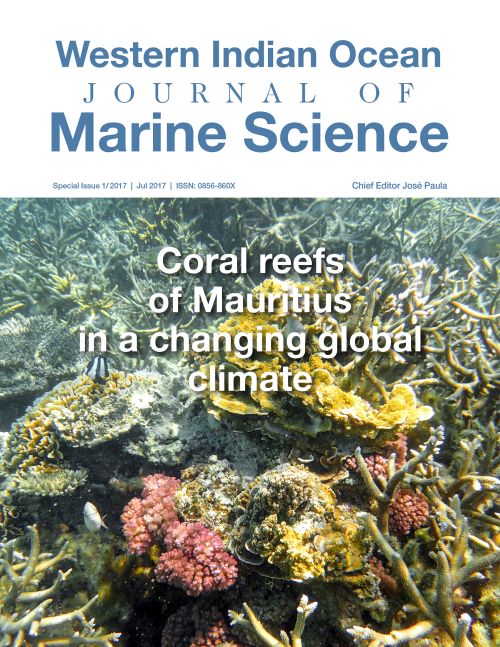

Received:
Dec 23, 2016Accepted:
Jul 4, 2017Published:
Aug 14, 2017Keywords:
Article Details
Copyright is owned by the journal. The articles are open access articles distributed under the terms and conditions of the Creative Commons Attribution (CC BY 4.0) licence.
Main Article Content
Chemical and biological characteristics of Albion reef in the South-West of Mauritius Island with special reference to primary production and N2 fixation of benthic substrata
Abstract
The role of heterotrophic bacteria, pico-cyanobacteria and benthic cyanobacterial mats was assessed in the cycling of organic carbon and nitrogen in the Albion lagoon, Mauritius. Surveys and sampling for biological and chemical parameters were undertaken at three locations along one northern (T1) and one southern (T2) transect perpen- dicular to the shore. Low levels of nutrients showing a typical oligotrophic condition promoted by a rapid water exchange with oceanic waters characterized this lagoon. A general trend in zonation was observed from the shore with seagrass beds followed by sand and rubble, with cyanobacteria forming mats. Coral cover increased towards the reef crest with dominating Porites spp. and Acropora spp. colonies, however coral cover was not higher than 20%. Heavy grazing of pico-plankton was detected in the middle of the lagoon between T1 and T2. In situ incubations on di erent substrata (coral rubble, cyanobacterial mats and surrounding seawater) revealed maximum primary pro- duction and nitrogen xation rates of cyanobacterial mats, with respectively 1-2 and up to 2 orders of magnitude higher levels found than other substrata. This study showed that cyanobacteria mats and coral rubble substrata con- stituted an important source of new nitrogen for the whole lagoon.

Tell us what you think and showcase the impact of your research!
Please take 5 minutes to contribute to our survey so that we can better understand the contribution that African research makes to global and African development challenges. Share your feedback to help us make sure that AJOL's services support and amplify the voices of researchers like you.
AJOL Stakeholder Survey
We will share a selection of stories of impact on our website for millions of users to see.
Journal Identifiers
eISSN: 2683-6416
AJOL is a non-profit, relying on your support.
AJOL's largest donor partners:


