



Article Sidebar

Published:
Jun 30, 2026Keywords:
Article Details

This work is licensed under a Creative Commons Attribution 4.0 International License.
Main Article Content
Distribution and conservation challenges of Vernonia glaberrima welw. Ex o.Hoffm. In the face of climate change in Togo
Abstract
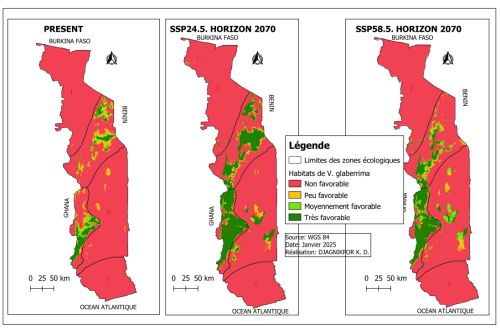
The degradation of ecosystems and the effects of climate change are increasing the vulnerability of Vernonia glaberrima, a medicinal plant in Togo. It is therefore necessary to understand its ecology in order to ensure its sustainable conservation. This study aims to determine the distribution of V. glaberrima in Togo and its vulnerability to climate change for the purposes of sustainable management. Specifically, it aims to: (i) identify the current habitat of V. glaberrima in Togo, (ii) assess the potential current impact of climate change on the population of V. glaberrima and by 2070 in Togo, and (iii) define priority areas for the conservation of V. glaberrima in Togo. To model the current and future potential distribution of V. glaberrima, the maximum entropy (MaxEnt) algorithm was used based on 21 bioclimatic variables and 146 points of presence of the species. Priority conservation areas were identified using Zonation software. The environmental variable that contributes most to the distribution model of V. glaberrima is annual precipitation (39.4%), followed by altitude (24%) and precipitation in the wettest quarter (13.4%). Under the current model, the results predicted highly favorable habitats covering 3.47% of Togo's land area. An increase in highly favorable areas is predicted by 2070 under scenarios SSP 24.5 and SSP 58.5. In terms of phytogeographic subdivision, ecological zones II and IV, representing 42.97% and 23.46% respectively, would be priorities for the conservation of V. glaberrima. These data will enable the sustainable management of the species in Togo.


