



Article Sidebar

Published:
Jul 7, 2026DOI:
10.4314/eajns.v5i3.2Keywords:
Article Details

This work is licensed under a Creative Commons Attribution-NonCommercial-NoDerivatives 4.0 International License.
Main Article Content
Early disturbances of consciousness after intracerebral hemorrhage in Burkina Faso: Prevalence and associated factors
Lompo Djingri Labodi

Zoungrana Alassane
Outtara Souleymane
Kere Fabienne
Napon Christian
Millogo Athanase
Abstract
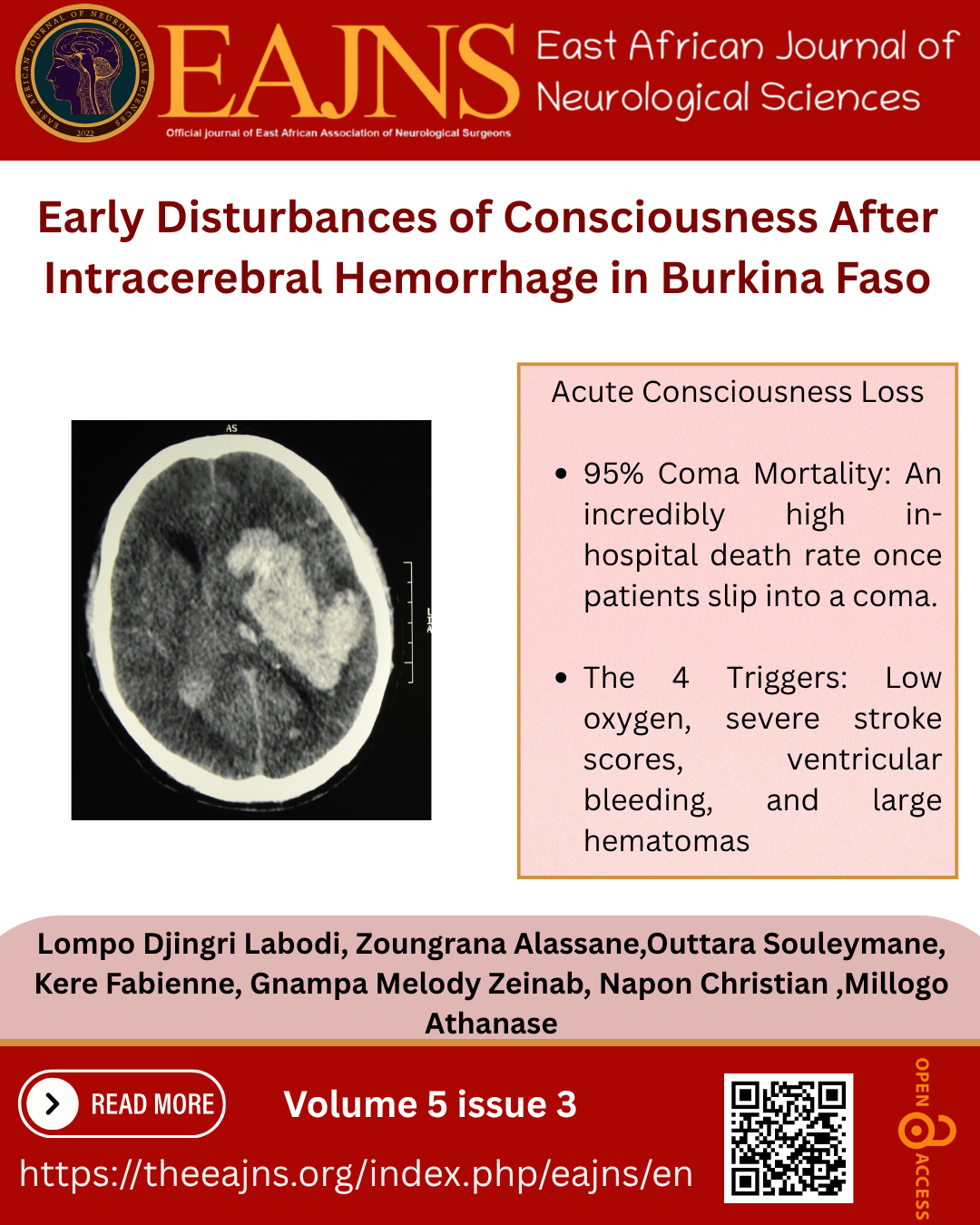
Background: Intracerebral hemorrhage (ICH) in sub-Saharan Africa is associated with high mortality, particularly in resource-limited settings. Early disorders of consciousness (EDC), occurring within the first 72 hours, are major prognostic indicators but remain understudied in Burkina Faso. Objective: This study aimed to determine the prevalence and factors associated with EDC during the acute phase of ICH in Ouagadougou. Methods: We conducted a descriptive and analytical cross-sectional study with prospective data collection from October 1, 2023, to October 31, 2024, in three university hospitals in Ouagadougou. Patients aged ≥15 years, admitted within 72 hours of symptom onset, and with CT- or MRI-confirmed ICH were included. Clinical, biological, and neuroimaging data were analyzed using multivariate logistic regression, with a significance threshold of p<0.05. Results: A total of 266 patients were enrolled, of whom 121 (45.5%) developed EDC within the first 72 hours. The mean age was 55.7 ± 13.6 years, and males predominated n(56.3%). Hypertension was the most common vascular risk factor n(69.4%). On admission, oxygen desaturation (<95%) occurred in n(42.1%) of cases, and n(38.0%) presented with coma (GCS ≤8). In multivariate analysis, independent predictors of EDC were oxygen desaturation on admission (OR 7.83; p<0.001), severe neurological deficit (NIHSS > 16: OR 5.57; p<0.001), intraventricular extension (OR 2.66; p=0.002), and hematoma volume > 30 cc (OR 2.87; p=0.004). Conclusion: Severe initial neurological impairment, oxygen desaturation, intraventricular hemorrhage, and large hematoma volume are major determinants of early disorders of consciousness, highlighting the need for intensive neurological and respiratory monitoring during the acute phase.


