



Article Sidebar

Article Details

This work is licensed under a Creative Commons Attribution-NonCommercial-NoDerivatives 4.0 International License.
Main Article Content
Surgical Management of Supratentorial Intra- ventricular Lesions: A Prospective Cohort Study at a Tertiary Centre in Upper Egypt (2022–2024)
Farrag Mohammad

Nour Imam
Ahmed Mohamed Elshanawany
Mohamed Aly Ragaee
Abstract
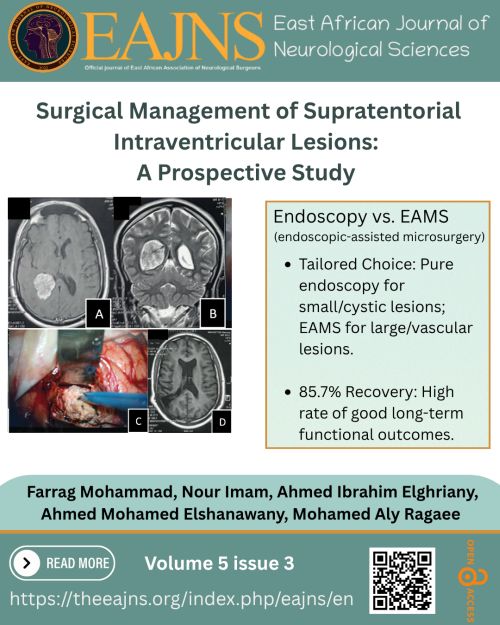
Background: Surgical management of supratentorial intraventricular lesions remains challenging because of their deep-seated location and proximity to critical neurovascular structures. Endoscopic techniques have expanded the surgical armamentarium, but their role as standalone or adjunctive procedures remains incompletely defined. Objective: To assess surgical outcomes and the feasibility of using endoscopy as either a sole or an adjuvant tool. Methods: This prospective clinical study included 35 consecutive patients with supratentorial intraventricular lesions treated over two years. Patients underwent either purely endoscopic surgery or endoscopic-assisted microsurgery (EAMS), with clinical and radiological outcomes assessed over 6 months. Predictors of functional outcome were evaluated using multivariable logistic regression. Results: Thirty-five patients (21 males, 14 females) with a mean age of 30.9 ± 17.0 years were included. Most lesions were located in the lateral ventricle (22/35, 62.9%), followed by the third ventricle (8/35, 22.9%) and combined lateral-third ventricular lesions (5/35, 14.3%). The commonest pathologies were colloid cysts (8/35, 22.9%), choroid plexus papillomas (7/35, 20.0%), and central neurocytomas (6/35, 17.1%). EAMS was performed in 28 patients (80.0%), while 7 (20.0%) underwent purely endoscopic surgery. Gross total resection was achieved in 20 patients (57.1%), with near-total resection in 9 (25.7%). At 6 months, favourable functional outcome (Glasgow Outcome Scale 4–5) was achieved in 30 patients (85.7%). Increasing age (OR 0.92 per year, 95% CI 0.85–0.99; p=0.033) and postoperative intraventricular haemorrhage (OR 0.03, 95% CI 0.001–0.58; p=0.021) were independent predictors of poorer functional outcome. Conclusion: Endoscopic-assisted microsurgery provides effective tumour resection with favourable functional outcomes for most supratentorial intraventricular lesions, while purely endoscopic surgery is best reserved for carefully selected small, cystic, or minimally vascular lesions. Advanced age and postoperative intraventricular haemorrhage independently predict poorer postoperative outcomes.


