



Article Sidebar

Published:
Jul 7, 2026DOI:
10.4314/eajns.v5i3.6Keywords:
Article Details

This work is licensed under a Creative Commons Attribution-NonCommercial-NoDerivatives 4.0 International License.
Main Article Content
Infected Separated-Type Subdural Hematoma: A Rare Clinical Variant?
Alliyy Loo

Musau Christopher
Julius Kiboi
Vincent Wekesa
Peter Kitunguu
Michael Magoha
Philip Maseghe Mwachaka
Mokaya Onsase
Nageyle Faisal
Abstract
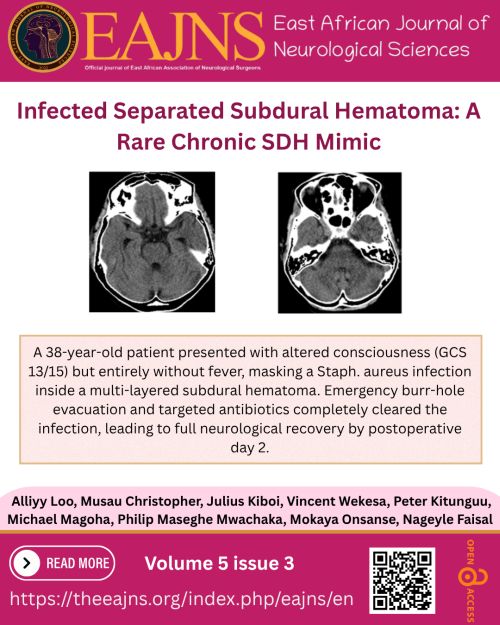
Background: Subdural haematoma (SDH) is a prevalent neurosurgical emergency, and its pathophysiology is consistently advancing with the discovery of novel varieties. The separated or multi-layered type, first described by Nakaguchi et al., is a unique pathoanatomic entity with particular imaging and clinical features. Case summary: This report details a rare case of an infected separated-type subdural haematoma in a 38-year-old female with a history of chronic alcohol use, intravenous drug use and head injury. She presented in a comatose condition without fever or focal neurological abnormalities. An axial non-contrast CT scan showed a right fronto-parietal subdural collection with multiple internal septations. We performed burr hole evacuation. Microbiological culture of the drained subdural contents revealed Staphylococcus aureus sensitive to cefotaxime, meropenem, and ceftriaxone. The patient regained full consciousness after the evacuation, and neurological function was intact within 24 hours. Infection of existing subdural hematomas by haematogenous methods is a rare yet complex condition commonly associated with immunosuppression, chronic alcohol use and old age. Common microbes isolated include Staphylococcus aureus, E. coli, H. influenzae, and Salmonella species. Conclusion: Infected separated-type SDH constitute a rare yet significant variant of chronic SDH. This condition is often misdiagnosed as a simple chronic subdural hematoma. Rapid diagnosis and appropriate antibiotic management are crucial to patient outcomes.


