



Article Sidebar

Published:
Sep 1, 2026Keywords:
Article Details
Papers that have already been accepted for publication in the Ethiopian Journal of Pediatrics will automatically become Journal’s copyright which Contributing Authors must clear by completing and signing the Copyright Form in accordance with Journal’s copyright policy before actual publication.
More information can be found at https://www.ejpch.net/index.php/ejpch/about/submissions.
Main Article Content
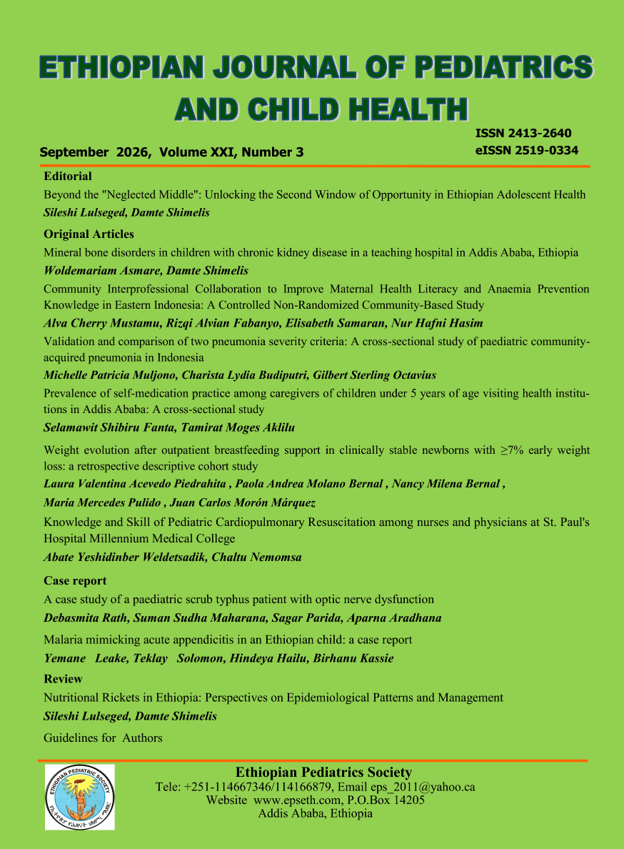
Community Interprofessional Collaboration to improve maternal health literacy and anaemia prevention knowledge in Eastern Indonesia: A controlled non-randomized community-based study
Abstract
Background : Maternal health literacy may influence preventive behaviours and service use in underserved settings. Evidence from eastern Indonesia is limited. We evaluated whether a Community Interprofessional Collaboration Package (CIPC) improved maternal health literacy and anaemia prevention knowledge while examining infant and young child feeding (IYCF) and age-appropriate immunisation.
Methods: This controlled, non-randomized study included 170 participants allocated to intervention (n=100) and control (n=70) areas in Aimas, Southwest Papua, Indonesia. CIPC was delivered over three weeks through household counselling and Posyandu education by nurses, midwives, nutritionists, and health workers, using adjusted difference-in-differences mixed-effects models. Maternal health literacy was assessed at baseline, post-intervention, and one-month follow-up; other outcomes were assessed at baseline and one-month follow-up.
Results: At one month, CIPC was associated with an adjusted 11.5-point greater increase in maternal health literacy (95% CI 6.8–16.2; p=0.003) and a 2.7-point greater increase in anaemia prevention knowledge (95% CI 2.1–3.3; p<0.001) than routine care. MDD and MMF showed complete baseline achievement in both groups, while MAD and immunisation were prevalent, limiting between-group differentiation and adjusted estimation. Sensitivity analyses produced consistent estimates for primary outcomes, while subgroup analyses showed no evidence of effect modification by education, parity, or socioeconomic status.
Conclusions: CIPC was associated with improvements in maternal health literacy and anemia prevention knowledge. Limited changes in IYCF and immunisation suggest that complex behavioural outcomes may require longer intervention exposure and stronger household and health-system support. Quasi-experimental or cluster-randomized studies with more clusters, longer follow-up, and objective outcomes can assess sustained effectiveness.


