


Article Sidebar
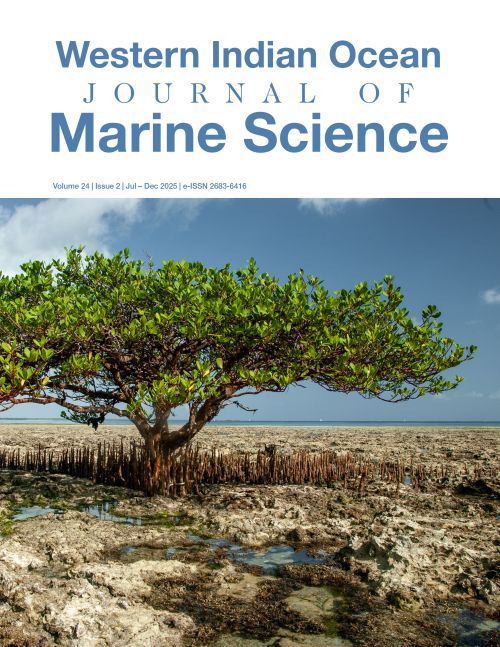

Received:
Nov 15, 2024Accepted:
Sep 9, 2025Published:
Dec 8, 2025Keywords:
Article Details

This work is licensed under a Creative Commons Attribution 4.0 International License.
Copyright is owned by the journal. The articles are open access articles distributed under the terms and conditions of the Creative Commons Attribution (CC BY 4.0) licence.
Main Article Content
Low mercury content in Seychelles seaweed: implications for aquaculture expansion
Bas de Vos

Shamira Payet
Maria Rose
Clémentine Violette
Rona Arrisol
Margaret Ally-Nourrice
Devis Monthy
Abstract
Stable tropical conditions and a near-pristine marine environment in the Seychelles suggest a high potential for seaweed aquaculture to supply growing global markets for sustainable marine products. The aims of this study were to assess the mercury content in five seaweed species that are candidates for aquaculture in Seychelles: Gracilaria cortica, Gracilaria salicornia, Caulerpa racemosa, Sargassum spp., and Asparagopsis taxiformis. Mercury contamination is a significant con- cern in seaweed aquaculture because it may bioaccumulate, potentially affecting human health when derived products are used. Samples were collected from different sites in Seychelles, categorized as polluted or unpolluted, to evaluate the influence of environmental factors on mercury accumulation. The results showed that mercury contents were low across all tested seaweed species and sites, with the highest observed content of 0.0038 mg/kg (wet weight), well below international safety limits. Significant differences were found between species; however, site pollution level did not significantly influence mercury content. Low mercury content, in addition to a favourable physical environment, confirm that the region is suitable for seaweed aquaculture. It is recommended that other heavy metal concentrations are also assessed, to pro- vide a comprehensive safety evaluation of seaweed aquaculture in Seychelles.

Tell us what you think and showcase the impact of your research!
Please take 5 minutes to contribute to our survey so that we can better understand the contribution that African research makes to global and African development challenges. Share your feedback to help us make sure that AJOL's services support and amplify the voices of researchers like you.
AJOL Stakeholder Survey
We will share a selection of stories of impact on our website for millions of users to see.
Journal Identifiers
eISSN: 2683-6416
AJOL is a non-profit, relying on your support.
AJOL's largest donor partners:


